EIT Urban Mobility, as lead of the EIT Community New European Bauhaus, invites organisations from across Europe to submit proposals to the Connect NEB & Co-create NEB 2027 Open Call, supporting local ideas and neighbourhood transformation inspired by the New European Bauhaus.
Deadline for applications: 30 September 2026 (17:00 CET)
Project proposals for both programmes must serve the purpose of achieving the 3 core values of the New European Bauhaus:
- Sustainable: from climate goals, to circularity, zero pollution and biodiversity,
- Beautful: quality of experience and style, beyond functionality,
- Together: from valuing diversity to equality for all, accessibility and affordability.
Proposals should take into consideration the relevance of integrating the three key NEB guiding principles:
- Multi-level approach: from global to local
- Participatory approach
- Transdisciplinary approach
The call offers two complementary funding opportunities for organisations creating more sustainable, inclusive and beautiful places across Europe:
1.) Connect NEB
Connect NEB is addressed to a single organisation that is part of, or directly connected to, the territory where the project will be implemented.
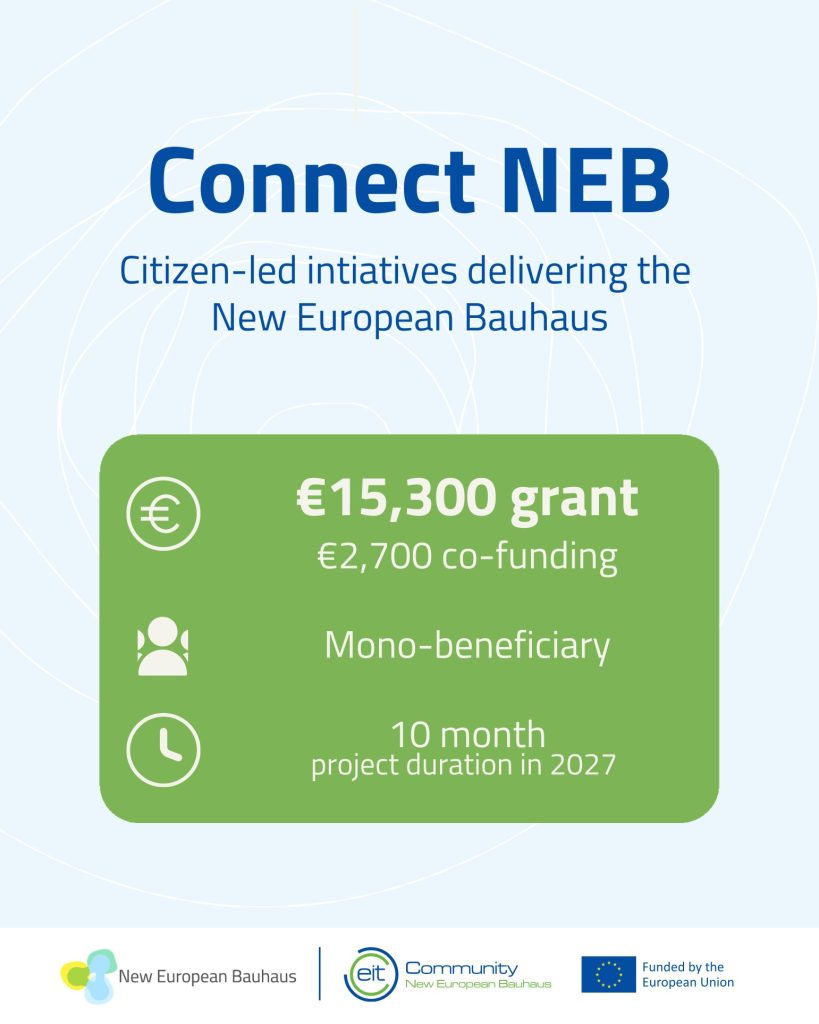
It is a small-scaled, citizen-led programme focusing on activating communities, testing ideas, and prototyping new forms of participation and governance through living labs, co-design processes, and community-led experimentation.
Objective: Improvement of communities’ quality of life through community-led participatory processes, living labs, and/or experimental prototyping solutions based on NEB values.
- Mono-beneficiary
- max. 10 months
- Budget: 15.300€ (2.700€ co-funding)
Key target applicant profiles include:
- Citizen-led collectives: Mobilised collectives or informal groups that are actively engaged in their local communities (applications must be submitted through a legally recognised entity)
- Social innovators, artists, and designers working with communities: Professionals or multidisciplinary groups whose practice contributes directly to the development of collaborative solutions, community participation in decision-making processes, artistic expression, and social cohesion;
- Local NGOs and third-sector organisations: Organisations embedded within the social fabric of the territory, with strong knowledge of local contexts, key stakeholder groups, and community needs;
- SMEs: Organisations operating locally and possessing the technical or strategic capacities needed to support improvements within communities in governance and organisational processes;
- Research groups: Collectives, laboratories, or academic groups working with applied territorial practices, engaging directly with communities through knowledge co-creation and bottom-up approaches.
2.) Co-create NEB
Co-create NEB is a place-based implementation programme that supports the transformation of neighbourhood public spaces through collaboration between communities and public authorities.
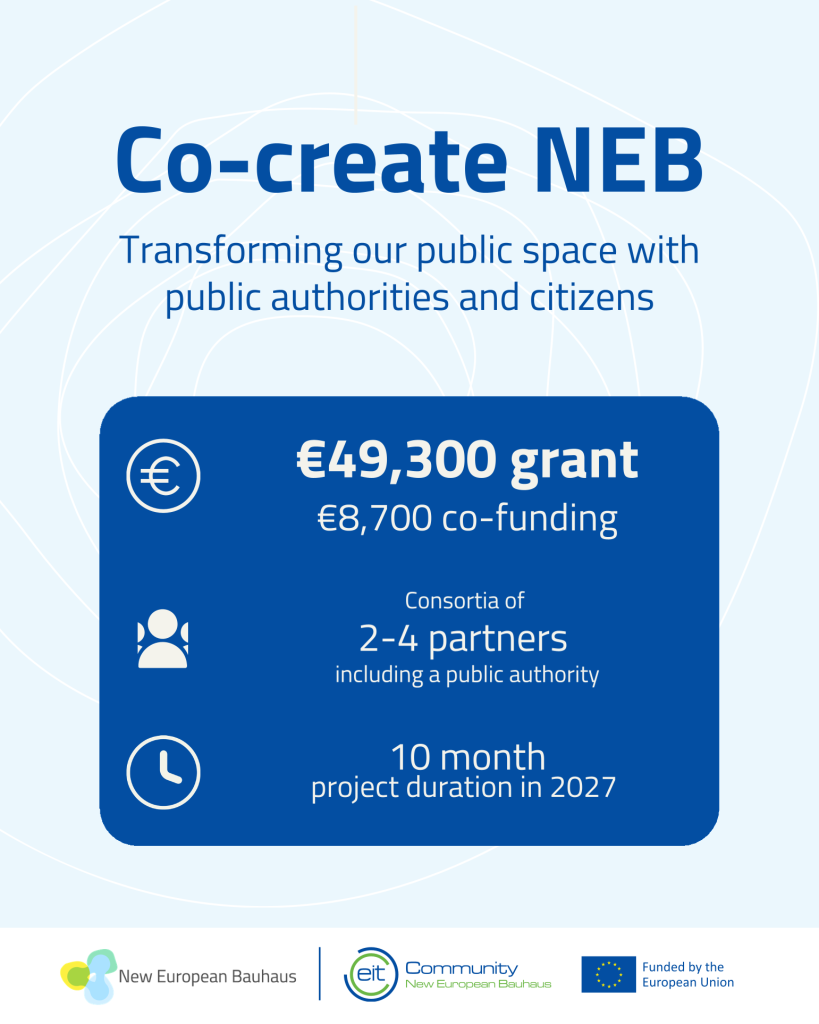
It requires the involvement of a consortium of 2 to 4 organisations, with at least one a city, region, or an entity affiliated with a city or region. Diverse consortia is strongly encouraged, recognising the range of groups and entities that constitute and support the community fabric, as well as the wide spectrum of disciplines and areas of knowledge related to public spaces, the built environment, and community engagement.
Objective: Transformation of neighbourhood public spaces through collaboration between communities and public authorities.
- Consortium
- max. 10 months
- Budget: 49.300€ (8.700€ co-funding)
Key target applicant profiles include:
- Citizens’ organisations: Legally established entities formed by residents with the purpose of improving the quality of life within their neighbourhoods, including initiatives focused on public spaces;
- NGOs and third-sector organisations: Entities working closely with communities to foster social wellbeing, and participation in decision-making processes related to shared spaces and collective life;
- SMEs: Organisations capable of addressing the priorities, interests, and needs identified by citizens in their neighbourhoods and regions;
- Research institutes and universities: Academic experts and centres prioritising co-creation approaches and producing knowledge that supports medium- and long-term impact in the public realm;,
- Municipalities and other public organisations: Public institutions representing the collective interest and able to support the implementation of proposals, ensuring equitable access to public spaces and reinforcing the long-term impact of the project through integrated strategies;
- Affiliated entities linked to public organisations: Entities committed to enhancing citizens’ quality of life and the improvement of shared neighbourhood spaces through public-interest initiatives;
- Private organisations: Consultancies, cooperatives, or other private entities with expertise and operational capacity that can contribute to community-centred initiatives and foster innovation and the development of sustainable solutions with social impact.
Co-create NEB projects will be coordinated by teams associated with the thematic areas with which the proposals are most closely aligned. These are:
- Urban Mobility:
• Adaptive re-use: turning old, unused infrastructure into integrated urban environments, such as converting former rail lines into greenways and cycle highways.
• Multi-modal green avenues: reimagine car dominated streets into space for walking, cycling and low-emission transit;
• Mobility hubs as multifunctional community anchors: strengthening community cohesion while enabling seamless, sustainable travel choices.
• Climate-responsive active mobility networks featuring. shaded pathways for heat resilience, rain-protected walkways and flood-adaptive design.
• Universal mobility: inclusive and accessible transport solutions ensuring equal mobility for all users. It may emphasise last-mile connectivity and micromobility options to enable seamless, sustainable travel.
• Redesign of streets and public space, by integrating continuous green corridors and adaptable kerbsides uses, to foster liveability and active and inclusive mobility.
2. Food:
• Food as a driver of healthy, inclusive neighbourhoods;
• Innovative local food systems: short chains, entrepreneurship, and urban food infrastructure;
• Regenerative and nature-positive food environments;
• Circular food systems in the public realm;
• Climate-resilient food systems and low-carbon food environments;
• Food literacy, trust and citizen engagement through place-making;
• Inclusive food economies and social innovation;
• Sustainable and healthy diets in practice: protein transition through place.
3. Climate:
• Climate resilience: infrastructures and protocols addressing environmental risks e.g. climate shelters, catastrophe proof gathering spaces;
• Built environment: energy efficient buildings, energy communities, electrification of heating and cooling, vertical space solutions, regeneration and repurposing of vacant and heritage buildings;
• Circular economy: sustainable value chains, waste management and valorisation, applied material innovation in public spaces, resource efficiency, new consumer and business models, sharing economy and alternative governance models;
• Blue economy: decarbonization of the maritime industry, aquaculture, natural carbon capture, ocean/tidal energy, coastal and habitat protection, ocean plastics reduction and recycling, water treatment.
• Agriculture: Regenerative agriculture and farming solutions, sustainable supply chains, water management, soil health enhancement, renewable energy integration.
*Applicants may apply to one or both programmes but can be eligible as the Lead Partner for only one programme.
Examples of best practices: https://www.eiturbanmobility.eu/communities-leading-change-18-new-european-bauhaus-initiatives-for-2025/